
How to Order Grass-Fed Meat Directly from a Local Farm
How to Order Grass-Fed Meat Directly from a Local Farm
Grass-fed meat is meat from animals raised on grass and forage, though labels and finishing practices can differ, so buying directly from a local farm starts with asking exactly how the animals were raised. To order, find nearby farms, compare their production and processing details, choose a package size and cuts, confirm the total price and delivery or pickup arrangements, and pay attention to safe handling. This guide explains how to verify a farm’s claims, understand bulk and individual-cut options, estimate costs and storage needs, and place an order with fewer surprises. The USDA’s Food Safety and Inspection Service (FSIS) emphasizes that meat labels are subject to specific requirements; “grass-fed” should therefore be treated as a claim to verify, not a complete description of an animal’s life or the meat’s nutritional profile.
How to Order Grass-Fed Meat Directly From a Local Farm
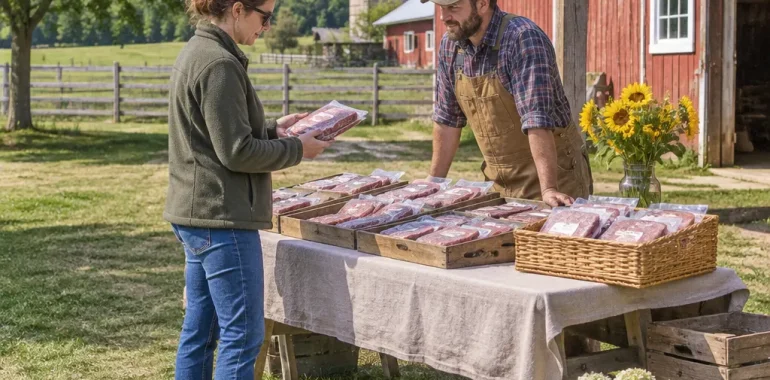
Ordering directly means buying meat from a farm or ranch, usually through its own website, farm store, farmers market, or a preorder arrangement. The farm may sell individual cuts or a share of an animal processed by a meat plant. Direct purchasing can give you a chance to ask the producer about feed, animal care, processing, and delivery—but the farm’s answers and written terms matter more than assumptions based on a label or marketing phrase.
Find farms and confirm what “grass-fed” means to them
Start with local farmers markets, agricultural directories, farm websites, and referrals from community food groups. Ask whether the animals ate grass and forage throughout their lives, whether they received grain at any point, and whether the farm uses the term “grass-finished.” These terms are not interchangeable in every seller’s usage. Request a clear description of the diet and finishing period, and ask whether the farm follows a third-party certification or has documentation supporting its claims.
The USDA Agricultural Marketing Service (AMS) has operated a voluntary verification program for certain agricultural marketing claims, including grass-fed claims. A claim of certification or verification should identify the certifier or program; do not assume that every farm is enrolled. Likewise, “local” does not by itself establish a particular production method, inspection status, or quality grade.
Choose individual cuts or an animal share
Individual cuts are typically easiest for a first order: choose items such as ground beef, steaks, roasts, or stew meat from the farm’s available list. A quarter, half, or whole-animal share may offer a broader selection and a lower price per pound, but it requires more freezer space and may involve a wait until an animal is processed. Ask whether the quoted price is based on live weight, hanging weight, or packaged take-home weight. These measurements differ, and processing fees may be charged separately.
Ask the farm for an example cut sheet and an estimated package breakdown before committing to a share. The final mix depends on the animal, cutting instructions, and processing yield; a quoted share weight is not necessarily the amount of meat that will fit in your freezer.
Check processing, inspection, and packaging details
Ask which processor handles the meat and whether it is inspected under applicable federal or state requirements. FSIS explains that meat sold across state lines generally must be inspected under federal requirements or come from a state program with standards at least equal to federal standards; rules can differ for sales confined to one state. If you plan to resell meat or buy for a business, do not rely on household direct-sale assumptions—check the relevant regulatory requirements.
Confirm whether cuts are vacuum-sealed or wrapped, how they are labeled, and whether custom cutting costs extra. Ask when the meat was processed, how it will be kept frozen or chilled before pickup, and what to do if a package arrives damaged or partly thawed.
How to Compare Farm Prices, Portions, and Ordering Terms
Once you know what the farm is selling, compare the full cost and practical terms rather than looking at a single per-pound figure. Prices can vary by cut, region, season, processing charges, and order size. USDA’s Agricultural Marketing Service publishes market information, but a national or regional market figure is not a direct quote for a particular farm’s grass-fed product.
Calculate the full cost
Before paying a deposit, ask for a written estimate that itemizes meat, processing, delivery or shipping, and any required deposit. If the price is based on hanging weight, ask the farm or processor for a realistic estimate of packaged take-home weight and explain what is included. For an individual-cut order, compare the prices of the cuts you actually use and check for minimum-order requirements.
- Ask whether the listed price includes processing and packaging.
- Confirm deposit, balance-due date, cancellation policy, and refund terms.
- Check whether delivery, insulated packaging, or pickup fees apply.
- Compare like with like: cut, package size, production claim, and included services.
Estimate freezer capacity and meal portions
A bulk order is only economical if you can store and use it. Ask the farm for the expected number and size of packages, then measure your freezer’s usable space rather than relying on its advertised capacity. Leave room for air circulation, and make sure the meat can be kept at a safe frozen temperature. For smaller households, individual cuts or a smaller share can reduce waste and make it easier to try the farm before placing a large order.
Review pickup, delivery, and payment arrangements
Farm orders may be collected at the farm, delivered on a route, or shipped in insulated containers. Confirm the date and time window, how long the meat may remain in transit, and what happens if you are unavailable. Use the farm’s stated payment method and retain the order confirmation, cut selections, and any written promises about production or delivery.
How to Store and Handle Farm-Direct Meat Safely
Direct purchasing does not change basic food-safety practices. Keep meat cold during transport, refrigerate or freeze it promptly, prevent raw juices from contacting ready-to-eat foods, and cook to a safe internal temperature. FSIS advises consumers to use a food thermometer rather than judging doneness by color alone.
Keep meat cold from pickup to storage
Bring a cooler for farm pickup, especially if you have a long drive, and keep packages separate from other groceries where practical. Refrigerate perishable meat promptly. If the meat is frozen, transfer it to a freezer without delay; if it arrives thawed, check that it is still cold and follow the farm’s and food-safety authorities’ guidance rather than refreezing meat that has been held at unsafe temperatures.
Use safe thawing and cooking practices
Thaw meat in the refrigerator, in cold water with appropriate precautions, or in a microwave when cooking immediately afterward—not on the counter. USDA FSIS recommends cooking ground beef to 160°F (71°C) and whole cuts of beef, such as steaks and roasts, to 145°F (63°C) followed by a three-minute rest. Use a clean food thermometer in the thickest part of the cut, and follow current guidance for other meats such as pork, poultry, and lamb.
A Practical Checklist for Placing Your First Order
A short conversation can clarify whether a farm’s products fit your budget, cooking habits, and storage space. For example, a household that cooks beef occasionally might start with a small assortment of individual cuts, while a household with a large freezer and regular beef meals may consider a share after reviewing the cut sheet and total costs.
- Find farms within a realistic pickup or delivery distance.
- Ask what “grass-fed” and “grass-finished” mean for that farm’s animals.
- Confirm inspection and processing arrangements, packaging, and product labels.
- Choose individual cuts or a share based on your meal plans and freezer space.
- Get the complete price, weight basis, fees, deposit terms, and pickup or delivery date in writing.
- Keep the confirmation and follow safe transport, storage, thawing, and cooking practices.
Conclusion: Order With Clear Questions and Realistic Expectations
Ordering grass-fed meat directly from a local farm is most straightforward when you verify the farm’s production claims, compare the complete price, understand whether you are buying cuts or an animal share, and confirm processing and delivery details. Plan freezer space before committing, keep meat cold, and use current food-safety guidance at home. Contact a nearby farm with the checklist above, request its cut list and written terms, and start with an order size that matches your household’s needs.
Sources: U.S. Department of Agriculture, Agricultural Marketing Service, Grass Fed Program, https://www.ams.usda.gov/services/auditing/grass-fed; U.S. Department of Agriculture, Food Safety and Inspection Service, Meat and Poultry Labeling Terms, https://www.fsis.usda.gov/food-safety/safe-food-handling-and-preparation/food-safety-basics/meat-and-poultry-labeling-terms; U.S. Department of Agriculture, Food Safety and Inspection Service, State Inspection Programs, https://www.fsis.usda.gov/inspection/inspection-programs/state-inspection-programs; U.S. Department of Agriculture, Food Safety and Inspection Service, Safe Minimum Internal Temperature Chart, https://www.fsis.usda.gov/food-safety/safe-food-handling-and-preparation/food-safety-basics/safe-temperature-chart; U.S. Department of Agriculture, Agricultural Marketing Service, Market News, https://www.ams.usda.gov/market-news.