
How to Order Fresh Food Directly from Local Farms
How to Order Fresh Food Directly from Local Farms
Fresh food from local farms can be ordered through farm websites, farmers’ markets, community-supported agriculture (CSA) subscriptions, food hubs, and online marketplaces. The best option depends on what you want—regular seasonal produce, a one-time order, or a wider selection that may include meat, dairy, and pantry goods—and on whether pickup or delivery is available in your area. The U.S. Department of Agriculture’s 2022 Census of Agriculture counted 116,617 farms that sold directly to consumers, showing that direct purchasing is a substantial part of U.S. agriculture. This guide explains how to choose an ordering channel, check farm practices and logistics, place and manage an order, and make the most of seasonal food.
How direct farm ordering connects shoppers with local food
Ordering directly from a farm means buying food through a channel managed by the producer or a partner that aggregates local producers, rather than relying solely on conventional retail distribution. The USDA defines a direct-to-consumer food marketing channel as one in which farms sell agricultural products directly to consumers for human consumption. Examples include farm stands, farmers’ markets, CSA subscriptions, online farm shops, and some food hubs.
“Local” does not have one universal mileage definition across all U.S. food programs. Ask how far the food traveled, where it was grown or raised, and whether the seller is the producer. Buying directly can make the source easier to identify and may help farms retain a larger share of the sale, although prices and producer margins vary. Local food is not automatically cheaper, more sustainable, or more nutritious: outcomes depend on the farm, crop, production method, transport, storage, and season.
The USDA’s 2022 Census of Agriculture reported 116,617 farms selling directly to consumers and approximately $3.3 billion in direct-to-consumer sales. These figures describe U.S. farm activity, not the value of every local-food channel, but they illustrate the scale of direct purchasing. The main ways to order differ in how much commitment, choice, and convenience they require.
Farm websites and online marketplaces
A farm’s own online shop lets customers browse available products, select quantities, pay, and choose an offered pickup or delivery option. Some regional marketplaces combine inventories from multiple farms, making it easier to buy produce alongside eggs, meat, bread, or other goods. Before paying, check which farm produced each item, order deadlines, minimums, delivery coverage, substitutions, and refund rules.
Farmers’ markets and farm stands
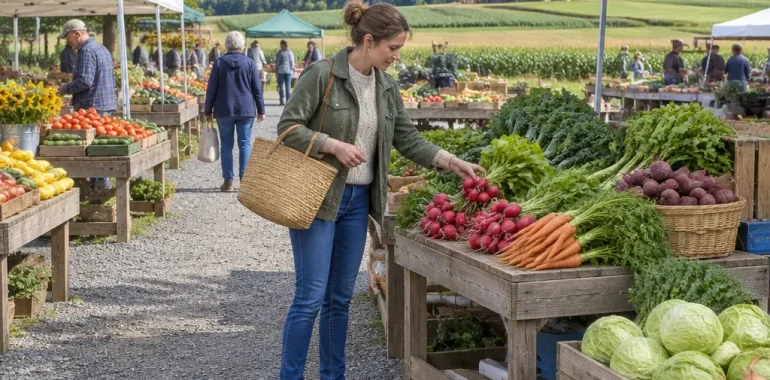
Farmers’ markets and farm stands provide in-person purchasing, with opportunities to ask about harvest timing, varieties, storage, and growing practices. Some vendors accept preorders for market pickup; others sell only what they bring that day. Check the market’s official schedule and the individual farm’s announcements, since hours, vendor attendance, and seasonal dates can change.
CSA subscriptions and food hubs
A community-supported agriculture (CSA) subscription typically involves paying in advance for a recurring share of a farm’s harvest. Members receive seasonal items on a set schedule, so contents may vary with weather and harvest conditions. A food hub, by contrast, aggregates products from multiple farms and coordinates ordering, packing, and distribution. Hubs can offer more variety than a single-farm share, but their delivery areas, fees, and producer information differ.
How to choose a farm-ordering option
Once the ordering channels are clear, compare them against your household’s budget, cooking habits, schedule, and tolerance for seasonal variation. A practical choice is one that you can use consistently—not simply one with an appealing product list.
Match the commitment to your routine
Choose a one-time online order or market visit if you want to test products before committing. Consider a CSA if you cook regularly, enjoy trying unfamiliar ingredients, and can collect a share on schedule. Ask whether the farm offers a small share, skipped weeks, vacation holds, or flexible payment. CSA terms are farm-specific, and a subscription may transfer some crop and weather risk to members.
Check product availability and seasonality
Farm inventories reflect local growing seasons, storage crops, harvest conditions, and the farm’s production choices. A listing may change or sell out quickly, particularly for limited harvests. Look for the farm’s current availability calendar, harvest notes, and substitution policy. If you need particular ingredients for a planned meal, confirm availability before placing an order.
Compare total cost and convenience
Compare the full cost, not just the listed price: include delivery charges, service fees, minimum order values, packaging deposits, and travel to pickup. A larger share can be good value only if you can use or preserve the food. For a fair comparison, consider the quantity, quality, variety, and handling of products alongside price.
How to verify farm practices and food handling
Direct ordering can make it easier to ask questions, but the phrase “local farm” alone does not certify a production method or guarantee a specific food-safety standard. Verify claims with the producer and consult official guidance where appropriate. The USDA’s Agricultural Marketing Service explains that organic products sold as certified organic must meet federal organic standards; other terms, such as “regenerative,” may not have one consistent legal definition across sellers.
Ask where and how the food was produced
Ask which farm grew or raised each item, where the farm is located, and whether the product was grown by the seller or sourced from another producer. For claims about organic certification, pesticides, animal care, or growing methods, request a clear explanation and ask what documentation or certification supports the claim. Different farms use different practices, and buying locally does not by itself establish that food is organic or pesticide-free.
Review pickup, delivery, and storage procedures
Confirm when an order will be packed, how long it may remain at a pickup site, and how chilled or frozen products are kept cold. The U.S. Food and Drug Administration advises consumers to refrigerate perishable food promptly and to keep refrigerators at 40°F (4°C) or below. Bring a cooler for a long trip home if purchasing temperature-sensitive foods, and follow the farm’s product-specific handling instructions.
Understand labels and seller policies
Read product descriptions for size, weight, cut, variety, and storage condition. For meat and dairy, check whether products arrive fresh or frozen and review any relevant inspection, labeling, and handling information. Before checkout, look for rules on cancellations, late pickup, damaged goods, substitutions, and refunds. Clear terms help prevent misunderstandings when harvests or delivery plans change.
How to place and manage a direct farm order
A successful first order starts with a small, manageable basket and a clear plan for collection and use. These steps work for most farm shops, marketplaces, and preorder systems.
- Find farms through a state or county agriculture directory, a farmers’ market vendor list, a food hub, or a search for farms near your town. Confirm that the ordering page is current.
- Review the farm’s product list, growing season, delivery or pickup area, payment methods, deadlines, fees, and customer policies.
- Choose quantities that fit your meals and storage space. For a first purchase, avoid ordering more unfamiliar produce than you can use.
- Submit the order and save the confirmation, pickup instructions, and contact information.
- Collect the order on time, check that the items match the receipt, and contact the seller promptly about a missing or damaged product.
- Store each item appropriately and share feedback. Useful feedback can help the farm improve product descriptions, packing, and future availability updates.
Plan meals around what arrives
A flexible meal plan helps prevent waste when a CSA share or harvest box contains changing items. Sort food soon after pickup, use delicate greens and ripe fruit first, and freeze or preserve suitable surplus. The USDA’s FoodKeeper resource provides storage guidance for many foods; safe storage times depend on the product and conditions, so follow current food-safety recommendations rather than relying on appearance alone.
Use a simple first-order example
A household testing local delivery might order a modest selection of seasonal vegetables, a carton of eggs, and one pantry item from a multi-farm hub. It can compare the delivered order with a similar market basket, noting fees, freshness, portion sizes, and convenience. Afterward, the household can decide whether to repeat the order, visit a farm stand, or try a CSA share. This small trial reveals practical fit without assuming that one channel is best for everyone.
Conclusion: Make local farm ordering work for you
Fresh food can be ordered directly from local farms through online farm shops, marketplaces, farmers’ markets, farm stands, CSA subscriptions, and food hubs. Compare commitment, seasonality, total cost, delivery or pickup, and the producer’s handling practices before buying. Start with a manageable order, verify claims and policies, and plan how to store and use the food. To take the next step, look up a nearby farm or market through a local agriculture directory and contact the seller with questions about current harvests and ordering options.
Sources: U.S. Department of Agriculture, 2022 Census of Agriculture, Volume 1, Chapter 1: U.S. National Level Data, https://www.nass.usda.gov/Publications/AgCensus/2022/Full_Report/Volume_1,_Chapter_1_US/; U.S. Department of Agriculture, Local Food Directories: National Farmers Market Directory, https://www.ams.usda.gov/local-food-directories/farmersmarkets; U.S. Department of Agriculture, Agricultural Marketing Service, National Organic Program, https://www.ams.usda.gov/about-ams/programs-offices/national-organic-program; U.S. Food and Drug Administration, Are You Storing Food Safely?, https://www.fda.gov/consumers/consumer-updates/are-you-storing-food-safely; U.S. Department of Agriculture, FoodKeeper App, https://www.foodsafety.gov/keep-food-safe/foodkeeper-app.