
How to Get Fresh Seasonal Vegetables Delivered Weekly
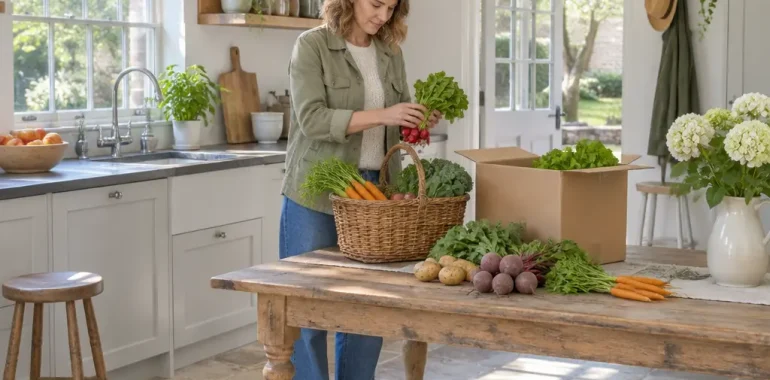
How to Get Fresh Seasonal Vegetables Delivered Weekly
Fresh seasonal vegetable delivery is a recurring service that brings produce grown or harvested in its natural local season to a household. To get it weekly, choose a farm or produce-delivery service that operates in your area, compare its sourcing and delivery schedule, select a box or custom order, and set a regular drop-off. Seasonal boxes can make local produce easier to access, but “seasonal” and “local” are not standardized guarantees, so it pays to check where food comes from, what substitutions are allowed, and how the service handles missed deliveries. The guide below explains delivery models, selection criteria, ordering, storage, and ways to make a weekly box work.
Choose a weekly model for seasonal vegetable delivery
A weekly produce delivery plan is a recurring arrangement in which a farm, food hub, grocery service, or produce retailer supplies vegetables to a customer on a set schedule. The U.S. Department of Agriculture (USDA) describes community supported agriculture (CSA) as a model in which consumers pay a farm in advance for a share of its harvest. That definition helps distinguish a CSA from an ordinary online grocery order: CSA members commonly share some of the season’s harvest risk, while a retailer usually sells produce by item or box.
Delivery options vary by harvest calendar, location, and business model. A weekly box can be a fixed assortment, a partly customizable share, or a flexible order assembled from an online catalog. Before signing up, confirm the service area, delivery day, fees, minimum order, season length, and cancellation rules.
Farm CSA shares
A CSA share is a planned portion of a farm’s harvest distributed to members during a specified season. It can suit households that enjoy trying unfamiliar vegetables and can use a variable assortment. Ask whether the share is weekly or every other week, whether the farm offers a small household size, and whether pickup is required or home delivery is available. Since crop yields and weather can affect the mix, a CSA box may not provide the same items every week.
Food hubs and local produce subscriptions
A food hub aggregates products from multiple farms and coordinates sales, packing, or distribution. A hub-based subscription may offer greater variety than a single-farm share, while still featuring regional produce. Ask how the provider defines “local,” how many farms contribute, and whether the box includes nonlocal items when regional supply is limited.
Retailer and online grocery produce boxes
Retailer boxes are generally ordered through a grocery service or produce company, with recurring delivery or scheduled weekly checkout. They may offer more control over individual items and substitutions than a farm share. However, a “seasonal” label alone does not establish that every item is locally grown or harvested in season. Review item descriptions and origin information, and compare the total cost—including delivery and service charges—with buying the same produce separately.
Evaluate freshness, seasonality, and sourcing
Freshness describes the condition and quality of produce at delivery, while seasonality refers to the period when a crop is naturally harvested in a particular growing region. The terms are related but not interchangeable: vegetables can be fresh after long-distance shipping, and a local product may be stored or grown under cover outside its usual field season. The USDA’s National Agricultural Statistics Service tracks U.S. agricultural production, while state extension services publish regional planting and harvest calendars that can help shoppers assess what is plausible locally.
Check harvest timing and growing region
Ask the provider which farms supply the box, where those farms are, and whether the listed vegetables are field-grown, greenhouse-grown, or stored from an earlier harvest. A regional extension office’s crop calendar can help you compare the current month with typical local harvest periods. These calendars are guides rather than guarantees: climate, elevation, rainfall, and growing methods shift harvest dates.
Look for practical freshness indicators
Produce quality is best judged by condition, not by a marketing phrase. On arrival, leafy greens should generally look crisp rather than wilted, roots should feel firm, and packages should be free of obvious leaks, decay, or excessive moisture. The USDA’s FoodKeeper guidance explains that storage life differs by food and storage conditions; use its recommendations or your local food-safety guidance rather than assuming every vegetable lasts the same number of days.
Understand labels and claims
“Local,” “organic,” and “seasonal” describe different attributes. In the United States, the USDA organic label is governed by federal standards and certification requirements, subject to specified exemptions. “Local” does not have one universal distance definition across all sellers, and “seasonal” may refer to a crop’s season somewhere in the supply chain rather than your own region. Read the provider’s definitions and ask for farm or origin details if those distinctions matter to you.
Set up a reliable weekly order
A reliable subscription combines a delivery cadence with a box size and substitution policy suited to the household. The USDA’s Economic Research Service reports that food loss and waste occur at multiple stages of the food system; at home, planning meals and storing food appropriately can help prevent edible produce from being discarded. A weekly box is most useful when its contents fit your cooking habits and the amount you can use.
Choose a box size and delivery frequency
Estimate how many meals you cook at home and how much produce you already buy. If the service offers sample contents or weights, compare those with your usual weekly use. Start with a smaller share or less frequent delivery if you are unsure, then adjust after tracking what gets eaten. Confirm whether the subscription renews automatically and how far in advance you must pause or cancel.
Compare cost and delivery terms
Compare the full weekly cost: produce price, delivery charge, membership fee, packaging deposit, and any minimum order. Also check whether the provider delivers to your door, leaves the box in a cooler, or requires a pickup. Ask what happens if you are away, the delivery is late, or produce arrives damaged. A clear refund, credit, or replacement policy is a practical sign of a well-defined service.
Use a simple order checklist
- Confirm that your address is within the delivery area and identify the regular delivery day.
- Review a sample box, portion size, and any customization or substitution options.
- Read the sourcing definitions, fees, renewal terms, and pause or cancellation policy.
- Choose a box size that matches your meal plan and household capacity.
- Set a reminder to check the delivery, store the produce, and plan meals promptly.
Store and use the weekly harvest
Good storage protects quality and helps a weekly delivery last until the next order. Different vegetables have different temperature, moisture, and handling needs, so avoid putting every item into one bag or drawer without checking. The USDA FoodKeeper resource provides food-specific storage guidance; local cooperative extension services also publish practical advice for handling garden and market produce.
Sort the box as soon as it arrives
Separate vegetables that need refrigeration from those better kept in a cool, dry place, and remove damaged items so they do not affect the rest. Keep produce in clean containers or breathable bags when appropriate, and follow the service’s handling instructions. Wash produce under clean running water before preparation, rather than washing everything far in advance if added moisture could shorten storage life.
Plan meals around the most perishable items
Use tender greens, herbs, and other delicate vegetables early in the week; save sturdier roots and winter squash for later meals when storage guidance permits. A flexible meal plan can turn an unfamiliar item into soup, a roast vegetable tray, a stir-fry, or a grain bowl. If the box includes an item you do not recognize, ask the farm for a recipe or consult a trusted extension or public-health cooking resource.
Track what your household actually uses
Keep a short record of what was eaten, what spoiled, and which items you wanted more or less of. After a few deliveries, use that record to change the box size, skip weeks, or select a more customizable service. For example, a household that regularly discards surplus greens may benefit from a smaller share, while a family that cooks soups and roasts may be able to use a more varied fixed box.
Conclusion: make weekly vegetable delivery fit your routine
To get fresh seasonal vegetables delivered weekly, first choose among a farm CSA, food hub, or retailer subscription; then verify the provider’s seasonality and sourcing claims, compare the full delivery terms, and select a share size you can use. A regional harvest calendar and food-specific storage guidance can help you judge what is in season and keep it in good condition. Start with a manageable order, track what your household eats, and adjust the plan over time. For further guidance, consult your state cooperative extension’s crop calendar and the USDA’s FoodKeeper resource.
Sources: U.S. Department of Agriculture, Community Supported Agriculture, https://www.nal.usda.gov/farms-and-agricultural-production-systems/community-supported-agriculture; U.S. Department of Agriculture, National Agricultural Statistics Service, https://www.nass.usda.gov/; U.S. Department of Agriculture, FoodKeeper App, https://www.foodsafety.gov/keep-food-safe/foodkeeper-app; U.S. Department of Agriculture, Organic Standards, https://www.ams.usda.gov/grades-standards/organic-standards; U.S. Department of Agriculture, Economic Research Service, Food Loss and Waste, https://www.ers.usda.gov/data-products/food-availability-per-capita-data-system/food-loss/; University of Minnesota Extension, Harvesting and Storing Vegetables, https://extension.umn.edu/planting-and-growing-guides/harvesting-and-storing-home-garden-vegetables.