
Can Regenerative Farming Actually Be Profitable?
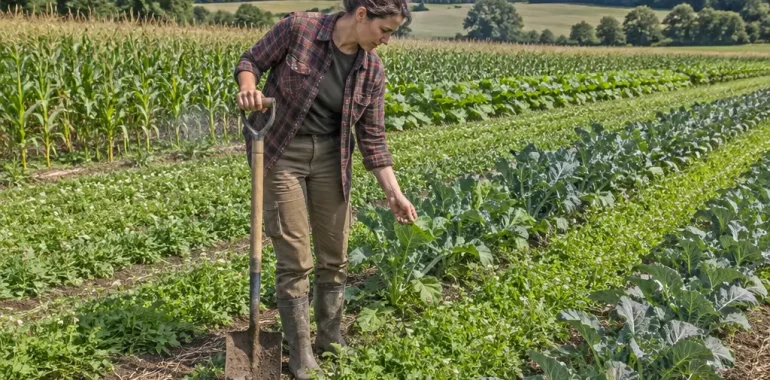
Can Regenerative Farming Actually Be Profitable?
Regenerative farming can be profitable, but it is not a guaranteed premium-price system: results depend on a farm’s starting soil and finances, which practices it adopts, how quickly it reduces input costs, and whether it can manage transition risk. Here, regenerative farming means farming approaches intended to improve soil function and ecosystem health while sustaining production. Evidence offers reasons for optimism: a peer-reviewed analysis of 100 case studies across 25 countries found that farms using diversification practices—including rotations, cover crops, and intercropping—had higher biodiversity and, on average, 20% higher economic returns than conventional comparison farms. But that finding does not mean every regenerative farm earns 20% more. This article examines the main profit mechanisms, transition costs, evidence limits, and practical ways to assess a farm’s business case.
Profitability depends on how regenerative farming changes farm economics
Regenerative farming has no single, universally accepted certification or fixed practice list. The U.S. Department of Agriculture’s Natural Resources Conservation Service (NRCS) describes soil health through the continued capacity of soil to function as a vital living ecosystem. In practice, regenerative approaches commonly combine reduced soil disturbance, living roots for more of the year, diverse rotations, cover crops, managed grazing, and integration of livestock where appropriate.
For a business, the relevant question is not whether a practice is labeled regenerative, but whether its effect on revenue, costs, risk, and long-term assets improves net returns. A useful farm-level calculation is: net operating return equals crop and livestock revenue plus verified incentives, minus seed, fertilizer, pesticide, fuel, labor, machinery, land, financing, and transition costs. Soil improvements may also contribute to the farm’s long-run productive capacity, but their financial value should not be counted as immediate cash income unless they reduce costs, improve yields, or generate a paid ecosystem-service benefit.
Cost reduction is a potential profit pathway
Reducing purchased inputs can raise margins when output is maintained. Cover crops, rotations, and biological nutrient cycling may gradually reduce reliance on synthetic fertilizer or herbicides, while reduced tillage can lower fuel and machinery wear. However, costs may shift rather than disappear: cover-crop seed, termination, additional management, specialized equipment, and labor all have a price. The farm should compare total costs per acre and per unit of output, not just fertilizer or fuel bills in isolation.
Revenue gains can come from yield, quality, or market access
Revenue may improve through higher yields, more stable production, better product quality, diversified crops, or access to buyers offering a premium. These gains are highly context-specific. A new crop may require different equipment, storage, contracts, or marketing skills; a premium may be too small or uncertain to cover those expenses. Regenerative claims alone do not guarantee a price premium, and farmers should confirm buyer specifications, volumes, contract duration, and verification costs before building a budget around one.
Resilience has economic value, but is difficult to price
Soil cover, improved structure, and greater water infiltration may help farms withstand drought or intense rainfall. The business benefit may appear as fewer crop failures, less erosion, or lower yield volatility rather than a higher average yield in every year. Resilience is therefore best assessed across multiple seasons and weather conditions. A single favorable harvest cannot establish that a system is more profitable or more climate-resilient.
Research finds promising returns, with important limits
The strongest broad evidence supports the potential of diversified farming, not a guaranteed return from every practice sold under the regenerative label. In a 2019 Nature Sustainability study, researchers analyzed 100 studies covering 2,655 farms in 25 countries. Farms using diversification practices had, on average, 20% higher economic returns than comparison farms, alongside gains in biodiversity. The practices included combinations such as crop diversification, intercropping, and agroforestry. Because the analysis examined diverse farming systems and locations, its average is evidence of potential—not a forecast for an individual operation.
Diversification can improve whole-farm returns
Diversification spreads production across crops, livestock, or seasons, potentially making better use of land and labor while reducing reliance on one commodity. It can also support beneficial ecological interactions. The economic result depends on whether the farm has viable markets and the capacity to manage added complexity. A diverse rotation that improves soil but lacks a dependable buyer may not improve cash flow.
Cover-crop economics vary by location and purpose
Cover crops are planted primarily to protect and improve soil rather than to harvest as the main cash crop. Their costs include seed, planting, and termination; potential benefits include erosion control, nutrient capture, forage, and improved soil cover. A 2020 review in Agricultural Systems found that cover-crop profitability varied substantially across studies and depended on factors such as crop choice, climate, management, and whether benefits to the following cash crop were included. Farmers should therefore calculate local costs and benefits over a rotation, rather than assume the cover crop pays for itself in its first season.
No-till and reduced tillage are not automatic savings
Reduced tillage can cut the number of field passes and conserve surface residue, but results depend on soil type, weed pressure, crop sequence, and equipment. Some farms may initially spend more on herbicides or specialized machinery, while others reduce fuel and labor costs. The USDA Economic Research Service has emphasized that conservation practices can have both private and public benefits, but adoption and financial outcomes vary with farm conditions and policy support.
Together, these findings suggest that regenerative profitability is a systems question: practices interact, and the relevant unit of analysis is often the full rotation or whole farm. That makes transition timing and financial capacity central to the decision.
Transition costs and timing determine whether gains reach the bottom line
Transition costs are the expenses and foregone income incurred while a farm changes its management system. They can include new equipment, seed, learning, labor, certification, and temporary yield changes. A farm may ultimately save on inputs but still face a cash-flow squeeze before those savings appear. The risk is particularly important for farms with high debt payments, rented land, or short-term leases that make it difficult to capture long-term soil benefits.
A phased transition can limit financial exposure
Rather than convert every field at once, farmers can test practices on selected acres, compare them with conventional management, and expand when results justify it. Record costs, yields, labor, and field conditions by management zone. A multi-year trial is more informative than a one-season comparison because weather and crop prices can overwhelm the effect of a practice in any single year.
Public programs can help, but are not a substitute for a sound budget
USDA conservation programs can provide technical and financial assistance for eligible practices. NRCS’s Environmental Quality Incentives Program (EQIP), for example, offers contracts to support conservation improvements. Payments can reduce transition costs, but availability, payment rates, eligibility, and timing differ by program and location. A farm should evaluate whether the system remains viable after temporary cost-share payments end.
Carbon and ecosystem-service income require verification
Some farms explore carbon-credit or other ecosystem-service markets as an additional revenue source. These programs may require measurement, reporting, verification, contractual commitments, and proof that credited outcomes are additional and durable. Payments can also be uncertain and may not cover participation costs. Farmers should examine the contract’s duration, data rights, reversal liability, fee structure, and restrictions on future land management before counting credit revenue in a profitability forecast.
Real-world evidence shows why farm-specific accounting matters
Farm case studies help show how practices work in context, but they should not be treated as universal financial benchmarks. Soil, rainfall, crop prices, farm size, labor availability, and management experience all affect outcomes. Comparisons are strongest when they report both gross revenue and full costs over several years.
The Iowa cover-crop evidence illustrates the role of local measurement
The Practical Farmers of Iowa has published farmer-reported cover-crop budgets and field experiences, including estimates of seed, planting, and termination costs alongside potential benefits such as grazing and changes to following-crop performance. These farmer-led records are useful for identifying relevant budget items and management questions, but results vary by farm and should be checked against local prices and conditions. They illustrate why a cover crop used for forage may have a different business case from one planted solely for soil cover.
Long-term comparisons are more useful than headline yield claims
The Rodale Institute’s Farming Systems Trial, launched in 1981, compares organic and conventional grain systems and provides a long-running example of how diversified rotations and management systems can be evaluated over time. It is not a direct test of every regenerative practice, and organic certification is not synonymous with regenerative farming. Its broader lesson is methodological: compare yields, input costs, soil outcomes, and performance under stress across many seasons, rather than relying on a single-year result or a marketing claim.
A practical framework for testing profitability
Before adopting a practice at scale, farmers can build a field-level budget and a whole-farm transition plan. Include both cash costs and opportunity costs, and test several scenarios for yields, prices, and weather. Where possible, use records from comparable local farms or university extension trials, while recognizing that another operation’s results may not transfer directly.
- Establish a baseline for yields, input use, fuel, labor, machinery, and gross margins.
- Define the intended outcome of each practice, such as reduced erosion, lower fertilizer use, forage production, or improved water infiltration.
- Estimate startup and recurring costs, including equipment, seed, termination, learning time, and any required verification.
- Track performance by field and season, including yield variability and costs per unit produced.
- Confirm markets and contract terms before relying on specialty premiums or ecosystem-service payments.
- Review results over multiple years and expand only when the financial and agronomic evidence supports doing so.
A useful visual for farm planning is a simple multi-year chart comparing conventional and regenerative acres by net return per acre, input costs, and yield variability. Showing transition expenses separately from recurring costs can reveal whether an apparent short-term loss is temporary, or whether the practice needs to be redesigned.
Conclusion: regenerative farming can pay, but profitability must be demonstrated
Regenerative farming can be profitable when practices fit the farm, improve whole-system returns, and are supported by workable markets and adequate transition finance. Research on diversification reports encouraging average economic outcomes, while evidence on individual practices such as cover crops and reduced tillage remains dependent on local conditions and accounting choices. The key business attributes are lower or better-targeted costs, reliable revenue, resilience, and a transition plan that preserves cash flow.
Farmers, lenders, and buyers should treat regenerative claims as a starting point for measurement, not proof of profitability. Begin with a baseline, test practices on a manageable scale, keep detailed records, and consult local extension or NRCS advisers. The broader opportunity is to build productive farms that sustain soil and financial health together—but the evidence must be measured in each farm’s fields and balance sheets.
Sources: United States Department of Agriculture, Natural Resources Conservation Service, Soil Health, https://www.nrcs.usda.gov/conservation-basics/natural-resource-concerns/soils/soil-health; Tamburini, G. et al., Agricultural diversification promotes multiple ecosystem services without compromising yield, Nature Sustainability, 2019, https://doi.org/10.1038/s41893-019-0414-0; Kaye, J. P. and Quemada, M., Using cover crops to mitigate and adapt to climate change: a review, Agronomy for Sustainable Development, 2017, https://doi.org/10.1007/s13593-016-0410-x; United States Department of Agriculture, Economic Research Service, Conservation Practices on U.S. Farms, https://www.ers.usda.gov/topics/natural-resources-environment/conservation-programs/; United States Department of Agriculture, Natural Resources Conservation Service, Environmental Quality Incentives Program, https://www.nrcs.usda.gov/programs-initiatives/eqip-environmental-quality-incentives; Practical Farmers of Iowa, Cover Crops, https://practicalfarmers.org/programs/cover-crops/; Rodale Institute, Farming Systems Trial, https://rodaleinstitute.org/science/farming-systems-trial/.