
Can Regenerative Agriculture Help Fight Climate Change?
Can Regenerative Agriculture Help Fight Climate Change?
Regenerative agriculture is a broad approach to farming that aims to restore soil and ecosystem health while producing food. It can help fight climate change by storing carbon in soils and vegetation, reducing emissions from farm inputs, and improving resilience to drought and heavy rain—but its climate benefits vary by place, practice, and duration, and it cannot replace rapid cuts to fossil-fuel emissions. The opportunity is significant: agriculture, forestry, and other land use accounted for about 22% of global greenhouse-gas emissions in 2019, according to the Intergovernmental Panel on Climate Change (IPCC). Understanding how regenerative practices work, what the evidence shows, and where the limits lie is essential to judging their role.
Climate benefits of regenerative agriculture
Regenerative agriculture has no single, universally accepted technical definition. The U.S. Department of Agriculture (USDA) describes regenerative agriculture as a conservation and rehabilitation approach to food and farming systems, while emphasizing that the term is not defined in federal law or regulation. In practice, it generally refers to farming systems intended to improve soil function, biodiversity, water management, and farm resilience.
Its climate contribution can come from several linked mechanisms: adding carbon to soil and perennial vegetation, limiting emissions associated with synthetic fertilizers and fuel, and protecting existing carbon-rich ecosystems from conversion. The National Academies of Sciences, Engineering, and Medicine has noted that agricultural soils have substantial potential to store carbon, but the amount depends on climate, soil type, land use, and management. Soil carbon gains also have limits: storage can slow as soils approach a new equilibrium, and some accumulated carbon can be lost if practices change.
Soil carbon sequestration
Soil carbon sequestration is the transfer of atmospheric carbon dioxide into soil organic matter through plant growth, roots, crop residues, and other biological processes. Cover crops and perennial plants can keep living roots in the ground for more of the year, while compost and retained residues can add organic material. The IPCC recognizes improved soil and crop management as a mitigation option, but estimates differ widely because results vary across farms and measurement methods.
A major qualification is that carbon stored in soil is not necessarily permanent. The National Academies has highlighted the need to account for saturation, reversals, and measurement uncertainty when evaluating soil-carbon projects. Claims should therefore be based on repeated sampling and transparent accounting rather than assuming that every acre using a regenerative label stores a fixed quantity of carbon.
Lower farm emissions
Regenerative practices may reduce emissions when they lower dependence on fuel-intensive field operations or synthetic nitrogen fertilizer. Nitrogen fertilizer production consumes energy, and nitrogen applied to soils can generate nitrous oxide, a powerful greenhouse gas. The IPCC identifies improved nutrient management and more efficient fertilizer use as ways to reduce agricultural emissions.
The outcome depends on the whole system. For example, reducing tillage may lower fuel use, but a farmer’s total emissions also reflect fertilizer, livestock, energy, and changes in yields or land use. A practice should not be described as climate-positive solely because it reduces one input; its effects need to be assessed against the farm’s overall emissions and production.
Climate resilience and ecosystem protection
Healthy soils can improve water infiltration and help crops withstand some drought and heavy-rain conditions. Diverse rotations, cover crops, and agroforestry can also support habitat and spread production risks. These benefits matter for climate adaptation, even when they do not translate directly into measured carbon removal.
Avoiding the conversion of forests, peatlands, grasslands, and other carbon-rich habitats is also critical. The IPCC identifies land-use change as a major source of emissions. A farming system that increases yields or soil carbon but encourages the clearing of natural ecosystems elsewhere could undermine its climate value, so land-use effects must be considered alongside on-farm practices.
Practices that make agriculture more regenerative
Regenerative agriculture is better understood as a collection of context-dependent practices than as a fixed recipe. USDA’s Natural Resources Conservation Service (NRCS) promotes related conservation methods through programs including its Conservation Stewardship Program. The appropriate combination depends on soil, rainfall, crop, livestock, equipment, and local economics.
Cover crops and diverse rotations
Cover crops are plants grown primarily to protect and improve soil between cash crops. They can reduce bare-soil exposure, capture nutrients that might otherwise leach, and add root and residue material. Diverse crop rotations can interrupt pest cycles and vary the timing and depth of root growth. The U.S. Environmental Protection Agency (EPA) identifies cover crops and crop rotation among agricultural practices that can improve soil health and reduce erosion.
Climate results are not automatic: cover crops require seed, labor, and water, and their performance depends on local growing conditions. Their carbon benefits should be measured alongside effects on fertilizer use, yields, and soil moisture.
Reduced tillage and no-till farming
Reduced tillage limits soil disturbance, while no-till planting places seed without conventional plowing. These methods can reduce erosion and fuel consumption and may help retain soil structure. They are often paired with residue retention and cover crops, since no-till alone does not guarantee higher soil carbon throughout the soil profile.
The U.S. Department of Energy’s technical and scientific assessments of soil carbon emphasize that changes can vary by soil depth and management history. This is why evaluations that sample only the surface may overstate or understate total carbon change. In some systems, weed control or fertilizer needs can also shift, affecting the full emissions balance.
Managed grazing and agroforestry
Managed grazing adjusts livestock movement and recovery periods to maintain pasture cover and avoid chronic overgrazing. Agroforestry integrates trees or shrubs with crops or livestock, adding long-lived biomass and potentially improving shade, habitat, and water management. The USDA describes agroforestry practices such as silvopasture, alley cropping, and windbreaks as ways to combine agricultural production with trees.
These approaches can increase carbon in vegetation and soils, but livestock systems also emit methane. The Food and Agriculture Organization of the United Nations (FAO) estimates that agrifood systems generated about 16.2 billion tonnes of carbon-dioxide equivalent in 2022, roughly 30% of global human-caused emissions; emissions from livestock and agricultural production are part of that total. Better grazing management may improve land condition, but it does not eliminate methane from ruminant animals.
Evidence, measurement, and real-world limits
Research supports the potential of regenerative practices to improve soil properties and deliver climate benefits, but it does not justify a single universal estimate of carbon removal per hectare. A 2020 review in the journal Global Change Biology found that no-till farming’s effects on soil carbon depend on soil depth, climate, and other management factors. The IPCC likewise stresses that land-based mitigation estimates carry uncertainty and must account for competing uses of land.
Why measurement matters
Soil carbon is difficult to measure because it varies across a field and changes slowly. Credible accounting needs a baseline, consistent sampling depth and methods, repeated measurements, and consideration of changes in bulk density and land management. It should also track emissions displaced or added elsewhere on the farm, rather than counting soil carbon in isolation.
For context, the IPCC estimated that agriculture, forestry, and other land use produced about 22% of net global greenhouse-gas emissions in 2019. That broad category includes emissions and removals from land and is not a measure of agriculture alone. The figure illustrates why land management matters, while also underscoring that regenerative farming is only one part of a larger climate strategy.
Adoption barriers and trade-offs
Farmers may face transition costs, uncertain yields, limited access to suitable equipment, new labor requirements, or a lack of reliable buyers willing to reward environmental outcomes. Some benefits take years to appear, while costs can arrive immediately. Technical assistance, crop insurance suited to diversified systems, research, and stable market incentives can help reduce these barriers.
Trade-offs also matter. Cover crops may compete for water in dry regions; reduced tillage can increase reliance on herbicides in some systems; and added grazing pressure can damage vegetation if stocking and recovery are poorly managed. These are not reasons to reject regenerative approaches, but they are reasons to adapt them to local conditions and evaluate environmental outcomes together.
A practical case: conservation systems in U.S. croplands
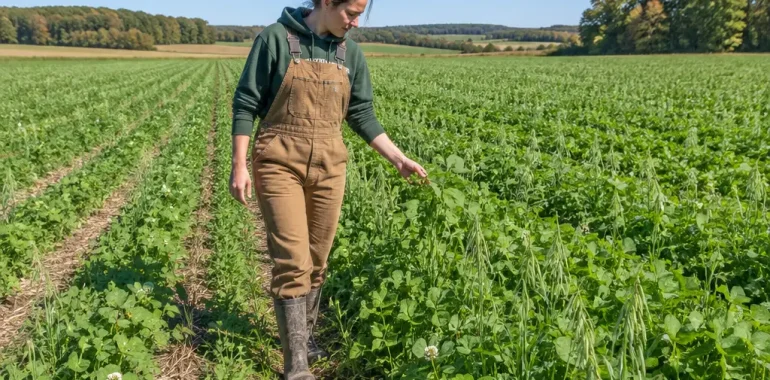
In the United States, farmers commonly combine practices such as cover cropping, crop rotation, and reduced tillage through NRCS conservation programs. These systems illustrate how regenerative principles can be implemented incrementally rather than as an all-or-nothing conversion. Their benefits may include reduced erosion, improved soil cover, and more efficient nutrient cycling; climate claims still require farm-specific data on soil carbon, fertilizer, fuel, and crop outcomes.
A useful way to present the evidence would be a chart comparing measured soil-carbon change, nitrous-oxide emissions, fuel use, and yield across several years for farms using different practice combinations. Such a chart should show uncertainty ranges and distinguish short-term results from long-term trends.
Conclusion: regenerative agriculture’s role in climate action
Regenerative agriculture can contribute to climate mitigation through soil-carbon storage, lower input-related emissions, and protection of resilient, carbon-rich landscapes. Cover crops, diversified rotations, reduced tillage, managed grazing, and agroforestry are among the practices that may deliver these benefits while improving soil and water outcomes. Their effects vary, soil carbon can saturate or be reversed, and livestock methane and other emissions remain important considerations.
The broader implication is that regenerative farming is a valuable tool, not a substitute for cutting fossil-fuel emissions or preventing ecosystem loss. Farmers, buyers, and policymakers can strengthen its contribution by funding transition support, protecting natural habitats, and requiring transparent, long-term measurement. Readers can explore the IPCC’s land-climate assessments and USDA conservation resources to learn how practices are evaluated and adapted to local conditions.
Sources: Intergovernmental Panel on Climate Change, Climate Change and Land: An IPCC Special Report, https://www.ipcc.ch/srccl/; Intergovernmental Panel on Climate Change, Climate Change 2022: Mitigation of Climate Change, https://www.ipcc.ch/report/ar6/wg3/; U.S. Department of Agriculture, Regenerative Agriculture, https://www.usda.gov/about-usda/news/blog/regenerative-agriculture; U.S. Department of Agriculture, Natural Resources Conservation Service, Conservation Stewardship Program, https://www.nrcs.usda.gov/programs-initiatives/csp-conservation-stewardship-program; U.S. Environmental Protection Agency, Agriculture and Soil Health, https://www.epa.gov/agriculture; National Academies of Sciences, Engineering, and Medicine, Negative Emissions Technologies and Reliable Sequestration: A Research Agenda, https://nap.nationalacademies.org/catalog/25259/negative-emissions-technologies-and-reliable-sequestration-a-research-agenda; Food and Agriculture Organization of the United Nations, Greenhouse Gas Emissions from Agrifood Systems, https://www.fao.org/newsroom/detail/FAO-analysis-reveals-rising-global-trend-in-greenhouse-gas-emissions-from-agrifood-systems/en; Luo, Z. et al., “A meta-analysis of the impacts of no-tillage on soil organic carbon and crop yields,” Global Change Biology, 2020, https://doi.org/10.1111/gcb.15009.