
Regenerative agriculture requires abandoning all modern farming technology and equipment
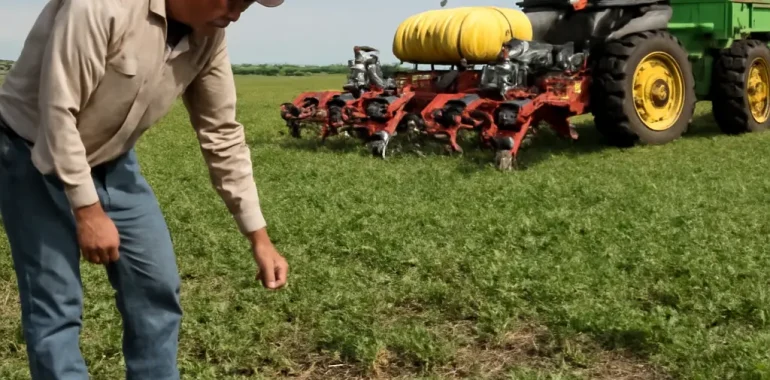
Regenerative agriculture requires abandoning all modern farming technology and equipment
Regenerative agriculture is a way of managing farms to rebuild soil health and support ecological processes while producing food and fiber. It does not require abandoning all modern technology or equipment: practices such as cover cropping, reduced tillage, diverse rotations, and managed grazing can be combined with tractors, precision tools, sensors, and contemporary seed and water-management systems. The relevant question is whether a tool supports the farm’s ecological and production goals—not whether it is modern. Evidence from the USDA, the National Academies, and farm research also shows why outcomes should be assessed locally: soil, climate, crop, and management choices influence results.
Regenerative agriculture requires selective technology, not its abandonment
“Regenerative agriculture” has no single, universally accepted legal or scientific definition. The U.S. Department of Agriculture’s Natural Resources Conservation Service (NRCS) describes soil health as the continued capacity of soil to function as a vital living ecosystem that sustains plants, animals, and people. In practice, regenerative approaches commonly aim to improve soil structure and biological activity, reduce erosion, maintain living roots, diversify crops, and integrate livestock where appropriate. These aims can be pursued with both traditional knowledge and modern equipment.
The scale of the issue is substantial. The Food and Agriculture Organization of the United Nations (FAO) estimates that about 33% of the world’s soils are moderately to highly degraded. That figure is not a measure of how much land must be farmed without machinery; it is a reason to adopt management that protects and restores soil. Technology can help farmers make those changes practical, but it cannot substitute for sound agronomy, local knowledge, or monitoring of actual results.
Modern technology can support regenerative agriculture when it serves soil-health goals
A useful definition of technology in regenerative farming includes the equipment, information systems, and management tools used to carry out or evaluate farm operations. NRCS soil-health guidance emphasizes principles such as keeping soil covered, minimizing disturbance, maintaining living roots, and increasing plant diversity. These principles describe desired management conditions; they do not prescribe a technology-free farm. A planter, tractor, satellite map, or sensor can be consistent with regenerative management if its use helps meet those conditions without creating unacceptable trade-offs.
The principal categories include machinery adapted for reduced soil disturbance, precision agriculture tools that guide inputs and field operations, and monitoring technologies that help assess soil and water. Their value depends on context. For example, a heavy machine used on wet ground can compact soil, while appropriately timed field traffic and controlled traffic lanes can reduce the area exposed to compaction. Likewise, a precision sprayer may reduce unnecessary chemical application, but it does not by itself establish that the overall system is regenerative.
Reduced-tillage equipment and cover-crop establishment
Reduced-tillage systems limit the extent or intensity of soil disturbance compared with conventional full-width tillage. They may use no-till drills, strip-till equipment, roller-crimpers, or planters designed to operate through crop residue. Cover crops are plants grown primarily to protect and improve soil between cash crops; they may reduce bare-ground periods, capture nutrients, and contribute roots and organic matter.
These practices are not universally beneficial in every setting. The National Academies of Sciences, Engineering, and Medicine’s report on soil health stresses that outcomes depend on soil, climate, crop sequence, and management. No-till may reduce erosion and fuel use in appropriate systems, but weed pressure, residue management, or cool and wet spring conditions can create challenges. Equipment therefore enables a practice; it does not guarantee a particular soil outcome. Farmers need to evaluate crop establishment, weed management, erosion, and soil condition over time.
Precision agriculture and efficient input use
Precision agriculture uses location-specific information—such as GPS guidance, yield maps, remote sensing, and variable-rate application—to make management decisions within a field rather than treating every acre identically. In regenerative systems, these tools can help identify differences in crop performance, target fertilizer or irrigation, plan traffic patterns, and monitor the effects of rotations or cover crops.
The USDA Economic Research Service has documented the adoption of precision agriculture technologies in U.S. crop production, including GPS-based guidance and yield mapping. Adoption varies by crop, farm size, and technology cost, so it should not be assumed that every operation can afford every tool. Nor does more data automatically mean better soil. Precision tools are most useful when they inform a clear management decision—for instance, avoiding excess fertilizer on areas unlikely to use it or identifying where erosion-control measures are needed.
Sensors, remote sensing, and soil-health monitoring
Monitoring technology includes soil-moisture sensors, weather stations, satellite imagery, and laboratory tests for properties such as organic carbon, nutrient levels, and aggregate stability. These tools can help farmers compare fields, schedule irrigation, spot crop stress, and track whether management changes are producing measurable results. Remote sensing can cover large areas efficiently, while field sampling remains important for verifying what imagery suggests.
A single measurement is rarely enough to establish that a farm has become regenerative. Soil-health indicators vary naturally across fields and seasons, and carbon measurements in particular require consistent sampling methods and repeated observations. The USDA’s Soil Health Assessment framework encourages a combination of biological, chemical, and physical indicators. Farmers and researchers should therefore pair digital tools with ground-level observations and comparable baseline data.
Regenerative farming practices can be combined with appropriate machinery
Technology is only one part of a farming system. Regenerative management is better understood through the practices it supports: diversified rotations, continuous soil cover, reduced disturbance, integrated livestock, and careful nutrient and water management. These practices can be adapted to farms with modern machinery, smaller equipment, or a mix of approaches. The practical choice depends on land, labor, markets, farm finances, and local ecological conditions.
Crop diversity, rotations, and cover crops
Crop rotation means growing different crops in sequence on the same land; cover cropping adds plants during periods when the main cash crop is absent or between rows. Diverse rotations can interrupt some pest and disease cycles and vary the timing and depth of root growth. Seed drills, planters, harvest equipment, and crop-management software can all be used in these systems. Their usefulness depends on whether the farm can establish, manage, and market the crops in the rotation.
The USDA Conservation Effects Assessment Project (CEAP) has documented the role of conservation practices, including cover crops, in reducing soil erosion and nutrient losses in agricultural watersheds. Results differ by region and practice combination, so estimates should not be treated as a guaranteed outcome for every field. A sensible assessment compares the field’s baseline condition with later measurements and considers both environmental benefits and operational costs.
Managed grazing and livestock integration
Managed grazing adjusts where and for how long livestock graze, with recovery periods intended to allow plants to regrow. Livestock can be integrated into crop systems through pasture rotations, grazing of cover crops, or use of crop residues. Fencing, water systems, livestock scales, and planning software may make these systems easier to manage; none requires rejecting modern equipment.
The outcome depends on stocking rate, timing, forage availability, soil moisture, and plant recovery. Poorly timed or excessive grazing can damage vegetation and compact wet soils, whereas well-managed grazing may fit a diversified farm system. The NRCS provides grazing-planning and conservation guidance that emphasizes matching livestock demand to forage and protecting land resources. That practical emphasis illustrates a wider principle: management quality matters more than whether the tools are old or new.
Technology has trade-offs that regenerative farms must manage
Rejecting the claim that all modern technology must be abandoned does not mean that every technology is automatically beneficial. Machinery can consume fuel, compact soil, and require substantial capital; digital systems can be costly, create data-management concerns, and favor larger operations. Conversely, well-chosen tools can reduce unnecessary field passes, improve the timing of operations, and help farmers detect problems earlier. Evaluation should consider the whole system, including soil impacts, energy use, labor, costs, and environmental outcomes.
Soil compaction, field traffic, and equipment weight
Soil compaction occurs when pressure reduces pore space, potentially restricting water movement and root growth. Heavy equipment and repeated traffic can increase the risk, particularly when soil is wet. Farmers can manage this risk through appropriate timing, fewer passes, controlled traffic, suitable tire pressure, and equipment choices that distribute loads more effectively. These measures adapt technology to soil-health goals rather than requiring its complete removal from the farm.
Because compaction varies by soil type and field history, visual inspection and targeted testing can be more useful than blanket rules. Soil structure, rooting depth, infiltration, and crop performance can help identify problem areas. A farm may choose smaller machinery in some fields or avoid operations under wet conditions; another may use precision guidance to keep repeated traffic in designated lanes.
Costs, access, and appropriate scale
The cost of equipment and digital services can limit adoption, especially for smaller farms and producers working with narrow margins. Regenerative transitions may also require new knowledge, different crop markets, or temporary changes in yield and labor. The USDA’s conservation programs, including Environmental Quality Incentives Program (EQIP) assistance, can help eligible producers implement conservation practices, although availability and program requirements vary.
A farm does not need to purchase every new device to improve management. Custom operators, equipment sharing, cooperatives, technical assistance, and staged changes can make practices more accessible. The appropriate technology is the least burdensome tool that reliably addresses a farm’s specific constraint, rather than the newest or most complex option.
Evidence and farm examples favor context-specific decisions
Long-term research helps distinguish promising practices from claims that are too broad. USDA Agricultural Research Service work at the Farming Systems Project in Beltsville, Maryland, compares organic and conventional cropping systems, including differences in rotations, tillage, and inputs. Such comparisons show why farming systems should be evaluated through multiple measures—crop performance, soil condition, biodiversity, and resource use—rather than by labeling a technology or production method as inherently regenerative.
The USDA’s Sustainable Agriculture Research and Education (SARE) program has also reported farmer experience with cover crops across U.S. regions. Its surveys have described growers’ reported benefits, including erosion control and improved soil health, alongside practical concerns such as establishment costs and management. These are farmer-reported results, not controlled proof that every cover crop succeeds; they provide useful context for decisions that should be tested locally.
A useful visual for readers would be a comparison chart showing management choices—such as conventional tillage, strip-till, and no-till—against indicators including soil cover, fuel use, compaction risk, weed-management needs, and equipment requirements. The chart should explain that ratings are context-dependent rather than universal. A second helpful graphic could show how baseline soil sampling, repeated measurements, and field observations work together to evaluate change over time.
Conclusion: regenerative agriculture is defined by outcomes, not technological rejection
Regenerative agriculture does not require farmers to abandon all modern technology or equipment. Its central aims—protecting and rebuilding soil, maintaining cover, diversifying crops, and managing water and nutrients—can be supported by appropriately selected machinery, precision tools, sensors, and monitoring systems. At the same time, equipment can cause harm when poorly timed or poorly matched to field conditions, and digital tools cannot replace agronomic judgment.
The most useful next step is to identify a farm’s specific goals, establish a baseline, and test practices at a manageable scale. Producers can consult local extension services, NRCS conservation planners, and research-based resources, then track soil, crop, and financial outcomes over time. The broader lesson is that regenerative farming is not a return to a technology-free past; it is a deliberate choice to use tools in ways that improve the resilience of agricultural landscapes.
Sources: Food and Agriculture Organization of the United Nations, Status of the World’s Soil Resources, https://www.fao.org/3/i5199e/i5199e.pdf; USDA Natural Resources Conservation Service, Soil Health, https://www.nrcs.usda.gov/conservation-basics/natural-resource-concerns/soils/soil-health; National Academies of Sciences, Engineering, and Medicine, Soil Health and Sustainability, https://nap.nationalacademies.org/catalog/25259/soil-health-and-sustainability; USDA Economic Research Service, Precision Agriculture in the Digital Era: Recent Adoption on U.S. Farms, https://www.ers.usda.gov/amber-waves/2023/june/precision-agriculture-in-the-digital-era-recent-adoption-on-u-s-farms; USDA Natural Resources Conservation Service, Soil Health Assessment, https://www.nrcs.usda.gov/resources/guides-and-instructions/soil-health-assessment; USDA Natural Resources Conservation Service, Conservation Effects Assessment Project, https://www.nrcs.usda.gov/about-nrcs/research-and-data/ceap; USDA Natural Resources Conservation Service, Environmental Quality Incentives Program, https://www.nrcs.usda.gov/programs-initiatives/eqip-environmental-quality-incentives; USDA Agricultural Research Service, Farming Systems Project, https://www.ars.usda.gov/northeast-area/beltsville-md-barc/beltsville-agricultural-research-center/sustainable-agricultural-systems-laboratory/docs/farming-systems-project/; Sustainable Agriculture Research and Education, Cover Crop Survey, https://www.sare.org/resources/cover-crop-survey/