
Rotating Crops Saved This Farm Thousands in Chemicals
Rotating Crops Saved This Farm Thousands in Chemicals
Crop rotation is the planned sequence of different crops on the same field across seasons or years. By interrupting pest and disease cycles and varying the plants competing with weeds, rotation can reduce reliance on pesticides and other crop-protection chemicals. A well-documented example comes from Iowa farmer Dick Thompson: a four-year rotation that included corn, soybeans, oats, and alfalfa cut herbicide use by about herbicide treatments compared with a conventional corn-soybean system, according to the U.S. Department of Agriculture’s Sustainable Agriculture Research and Education program. The experience shows why rotation can save chemical inputs, though results depend on the crops, pests, soil, and management practices involved.
How Crop Rotation Reduces Chemical Use
Crop rotation is a crop-management strategy in which a farmer changes the crop grown in a field over time rather than planting the same crop—or the same short sequence—repeatedly. USDA’s Natural Resources Conservation Service describes rotation as a planned sequence of crops on the same land. Its value goes beyond changing the harvest: different crops have different growth habits, nutrient needs, planting dates, and relationships with pests and weeds.
That variation can make a field less favorable to crop-specific insects, diseases, and weeds. It can also spread labor and planting risks across the season and improve soil cover when small grains or forage crops are included. Rotation does not automatically eliminate chemical use; farmers may still need pesticides, and a poorly designed sequence may do little to suppress a particular problem. The central question is whether the crop sequence disrupts the life cycles and growing conditions of the organisms that drive treatment decisions.
The Thompson farm example
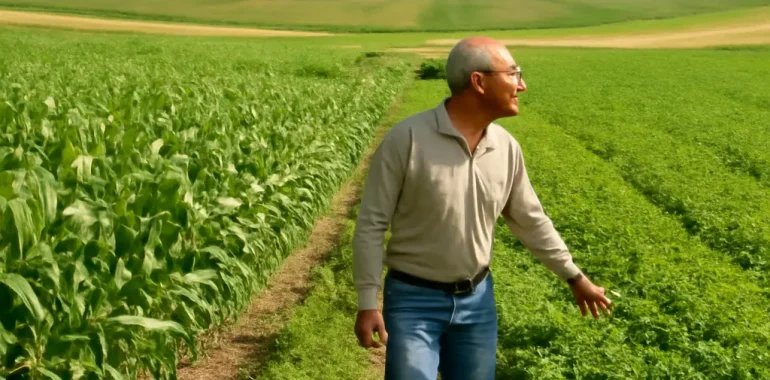
Dick and Sharon Thompson’s farm near Boone, Iowa, became a prominent example of diversified crop rotation. In place of a two-crop corn-soybean system, the farm used a four-year sequence of corn, soybeans, oats, and alfalfa. The sequence introduced small grains and perennial forage into a landscape otherwise dominated by annual row crops.
USDA’s Sustainable Agriculture Research and Education (SARE) program reports that the system required substantially fewer herbicide treatments than the conventional corn-soybean comparison—often summarized as roughly half as many. The practical lesson is not that every farm will achieve the same reduction, but that adding crop diversity can change weed pressure and reduce the need for repeated chemical control. Results are shaped by the specific rotation, weed species, field history, and the farmer’s use of cultivation and other integrated pest-management tools.
Why crop diversity matters
A crop sequence is more useful for pest management when its members differ meaningfully. Alternating two crops with similar planting dates or pest hosts may leave organisms undisturbed. In contrast, including a small grain, forage, or cover crop can change the timing of field operations and the availability of food and habitat for particular pests.
The National Academies of Sciences, Engineering, and Medicine has identified crop rotation as one part of integrated pest management: a broader approach that combines prevention, monitoring, and control rather than depending on a single pesticide. Rotation is therefore best understood as a preventive measure, not a guaranteed substitute for every treatment.
How Rotations Interrupt Weeds, Insects, and Disease
The chemical savings associated with rotation usually come from several mechanisms working together. Changing crop species can interrupt host-dependent pests, alter the timing of field disturbance, and create opportunities to manage weeds before they produce seed. Those effects can reduce pressure over time, although they vary by crop and region.
Weed management and herbicide resistance
Weed-management rotation means changing crops and, where possible, changing planting dates, tillage practices, and control methods so the same weed-control pattern is not repeated every year. Different crops allow farmers to use different herbicide modes of action and cultural practices, making it harder for weeds that survive one approach to dominate year after year.
This matters because herbicide resistance is a documented problem in U.S. agriculture. The International Herbicide-Resistant Weed Database tracks resistant weed cases by species, crop, and herbicide site of action. Rotation alone cannot reverse established resistance, but combining crop changes with varied control methods can help slow selection for resistant weeds. Farmers should follow local extension recommendations and product labels when choosing herbicides or other controls.
Insect and disease breaks
A rotation can suppress crop-specific insects and diseases when those organisms depend on a particular host plant or crop residue to survive. Growing a non-host crop can leave fewer opportunities for them to reproduce, while altered planting dates may help avoid periods of peak pest activity.
The effect is not universal. Some pests survive in soil or have broad host ranges, and some diseases can persist on residues for more than one season. Rotation plans therefore need to account for local pest biology and the crops grown nearby. University extension services and integrated pest-management programs can help farmers determine which sequences are most useful for specific threats.
Cover crops and forage crops
Cover crops and forage crops can add another layer of weed suppression by shading soil, competing for resources, or allowing mowing and grazing at times when annual row crops would not provide those options. In the Thompson rotation, oats and alfalfa diversified the sequence and created management opportunities beyond the corn and soybean phases.
The USDA Natural Resources Conservation Service notes that cover crops can support soil cover and reduce erosion when managed appropriately. Those benefits are related to, but distinct from, chemical savings: a cover crop may improve soil protection without necessarily reducing pesticide use in every field. Species choice, termination timing, water availability, and the following cash crop all influence outcomes.
Rotation’s Effects on Soil and Farm Economics
Reduced chemical dependence is only one measure of a rotation’s performance. A useful assessment also considers yields, input costs, labor, soil condition, and the value of the crops in the sequence. Diversification may bring benefits, but it can also require new equipment, markets, storage, and management knowledge.
Soil structure, fertility, and erosion
Different crops contribute different root systems and residues. Perennial forage roots can extend through the soil for multiple growing seasons, while small grains can provide residue that protects the surface after harvest. Legumes such as alfalfa can fix atmospheric nitrogen through associations with soil bacteria, potentially contributing nitrogen to the broader farm system.
These effects depend on soil type, weather, crop management, and the amount of biomass returned to the field. Rotation is not a stand-alone guarantee of improved soil health, but diverse sequences can complement practices such as reduced tillage, cover cropping, and nutrient planning. USDA’s Natural Resources Conservation Service treats crop rotation as one conservation practice among several that can be tailored to a farm’s resource concerns.
Costs, yields, and the value of diversification
A farmer evaluating rotation must compare the entire system, not just the price of herbicide. Fewer chemical applications may lower product and application costs, while additional crops can bring different seed, labor, machinery, and marketing expenses. A rotation may also reduce the financial risk of relying on a single crop, but only if there are viable buyers and suitable infrastructure for the added crops.
SARE’s account of the Thompson farm is valuable because it illustrates a real farm-level system rather than a single-input experiment. It should not be treated as a universal savings estimate: farm economics differ, and the reported reduction in herbicide treatments does not by itself establish the same percentage reduction in total chemical spending or environmental impact on every farm.
Planning a Rotation That Can Reduce Chemical Inputs
A practical rotation begins with the farm’s main weed, insect, disease, soil, and market constraints. Farmers can then choose a sequence that changes host plants and field operations while remaining feasible for their equipment and buyers. Monitoring is essential: a rotation should be adjusted when field records show that pest pressure or resistance is changing.
- Identify the weeds, insects, and diseases driving the most frequent treatments.
- Choose crops with different pest-host relationships, planting windows, and management requirements.
- Include small grains, forage, legumes, or cover crops where they fit the climate and farm business.
- Use multiple weed-control methods and follow pesticide labels and local recommendations.
- Record treatments, yields, costs, and pest observations to assess results over several seasons.
A chart comparing herbicide applications across rotation phases can help reveal whether chemical use is declining, shifting to another crop, or remaining unchanged. The most informative comparison tracks active ingredients, modes of action, application rates, costs, and weed outcomes—not just the number of spray passes.
Conclusion: Rotation as a Long-Term Farm Strategy
Crop rotation can save chemicals when a diverse sequence disrupts pests and weeds that would otherwise thrive under repeated planting of the same crops. Dick Thompson’s Iowa farm shows how adding oats and alfalfa to corn and soybeans can substantially reduce herbicide treatments, while also illustrating that outcomes depend on the whole management system.
The broader value of rotation lies in prevention: it can complement integrated pest management, diversify farm production, and support soil-protection goals. Farmers considering a change should consult local extension specialists, assess markets and equipment needs, and track field-level results over multiple years. The most useful next step is to identify one recurring pest or chemical cost and ask whether a different crop sequence could interrupt the conditions that keep it recurring.
Sources: USDA Sustainable Agriculture Research and Education, “The New American Farmer: Dick and Sharon Thompson,” https://www.sare.org/publications/the-new-american-farmer/dick-and-sharon-thompson/; USDA Natural Resources Conservation Service, “Crop Rotation,” https://www.nrcs.usda.gov/resources/guides-and-instructions/crop-rotation; National Academies of Sciences, Engineering, and Medicine, “Genetically Engineered Crops: Experiences and Prospects,” https://nap.nationalacademies.org/catalog/23395/genetically-engineered-crops-experiences-and-prospects; International Herbicide-Resistant Weed Database, “Global Herbicide-Resistant Weed Survey,” https://www.weedscience.org/.