
Farmers markets expose what big retailers hide about your food
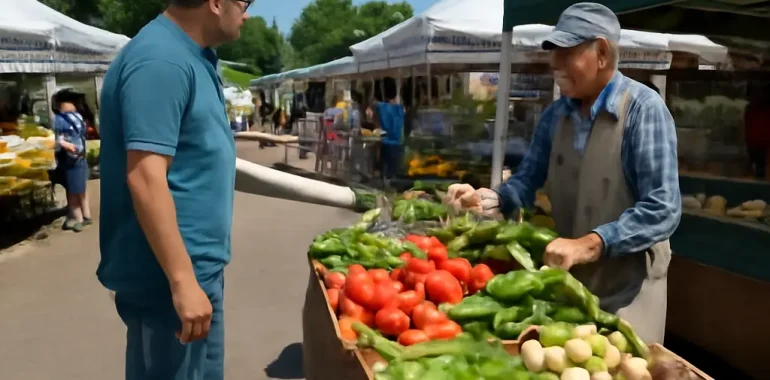
Farmers markets expose what big retailers hide about your food
Farmers markets make food details visible that can be difficult to trace on a supermarket shelf: who grew an item, where it came from, and when it was harvested. The U.S. Department of Agriculture’s 2020 Local Food Marketing Practices Survey counted 147,000 farms selling food through local and regional marketing channels, with $9 billion in sales. Those figures show that direct and regional food sales are a substantial part of U.S. agriculture—but they do not prove that every farmers-market product is local, organic, or more sustainable. The useful difference is transparency: shoppers can often ask sellers directly, check labels and certifications, and learn how products were grown, while still applying the same scrutiny to claims made at any store.
Farmers markets clarify food origin and producer identity
A farmers market is generally a recurring public market where multiple vendors sell food and other goods directly to customers. The USDA’s Agricultural Marketing Service describes farmers markets as places where producers sell products directly to consumers, although market rules and vendor requirements vary. This direct relationship can make the supply chain easier to question: a shopper may be able to speak with the grower, ask about harvest timing, and distinguish a farm’s own produce from items a vendor bought elsewhere.
Direct sales make the producer easier to identify
Direct-to-consumer sales are transactions in which a farm sells food to the person who will eat it, without relying on the full chain of distributors and retail intermediaries. The USDA’s 2020 survey found that 116,617 farms sold food directly to consumers, including through farmers markets, farm stands, community-supported agriculture programs, and online sales. A conversation at a stall can help clarify whether a farmer grew the produce, sourced it from another farm, or sells a mixture of both. Buyers can ask for the farm’s name and location rather than assuming that a market setting guarantees local origin.
Shorter supply chains can improve traceability
Traceability is the ability to follow food through its production and distribution stages. A shorter chain may make that path easier to explain, but it does not automatically make a product safer or its history fully documented. The U.S. Food and Drug Administration’s Food Traceability Rule establishes additional recordkeeping requirements for certain foods on the Food Traceability List as they move through covered supply chains. For shoppers, a practical market question is: “Which farm grew this, and how can I find out more?” The answer is useful context—not a substitute for required food-safety controls.
Farmers markets reveal production claims that labels may leave unclear
Food labels and seller statements are not interchangeable. Terms such as “local,” “natural,” “organic,” and “pesticide-free” have different meanings, and some are more strictly regulated than others. At a market, shoppers can ask what a claim means in practice and request supporting details. The same care matters in supermarkets: a product’s packaging may offer standardized information, but shoppers may need to inspect the label or consult certification records to understand a particular production claim.
“Local” describes proximity, not a single federal standard
The USDA’s Agricultural Marketing Service notes that there is no single, universally accepted federal definition of “local” food. The term can refer to geographic distance, a state or regional boundary, or a relationship between producer and customer. Ask sellers where a product was grown and when it was harvested; those answers are more informative than the word “local” alone. Supermarket products can also be locally sourced, while a farmers-market vendor may sometimes resell food grown elsewhere, depending on market rules.
“Organic” has a defined certification framework
Organic is a regulated production and labeling term, not a general synonym for small-scale, local, or pesticide-free farming. USDA National Organic Program standards govern how eligible products are produced, handled, and labeled. Farms and businesses generally must be certified to sell, label, or represent products as organic, subject to specific exemptions. Shoppers can ask a market vendor whether a product is certified organic or grown using particular practices; if a seller uses terms such as “grown without synthetic pesticides,” ask exactly what that statement covers. Avoid treating an informal claim as equivalent to USDA organic certification.
Production methods are best discussed specifically
Questions about fertilizer, pest management, animal feed, or growing conditions are more useful when they name a practice rather than rely on broad marketing language. For example, a shopper can ask what the farm does to manage pests, whether animals have outdoor access, or how produce is washed and stored. Farms differ, and direct access to a producer may make it easier to get a detailed answer—but neither a friendly conversation nor a market stall independently verifies every claim. Certifications, written farm policies, and inspection records can provide additional evidence where relevant.
Farmers markets connect seasonality with food availability
Seasonality means that foods are harvested or available at particular times of year in a given region. A market’s changing assortment can offer a visible reminder that crop availability depends on weather, location, and growing conditions. That can help shoppers understand why fresh local strawberries, apples, greens, or root vegetables appear at different times in different places. But seasonality is not proof of origin: imported and greenhouse-grown products can be available outside a local crop’s harvest period.
Market displays can show what is in season
A market’s produce selection often changes as crops are harvested, making seasonal variation tangible. Shoppers can ask which items were harvested recently, what is nearing the end of its season, and how a farm handles storage crops. The USDA’s seasonal produce guidance is one way to compare typical harvest periods, though actual timing varies by climate and year. A simple chart in a market guide could show local harvest months alongside the vendor’s farm location; readers should treat it as a planning aid, not proof that every item was grown nearby.
Seasonal buying does not guarantee lower impact
Environmental impact depends on more than distance. The production method, storage, refrigeration, packaging, transport mode, and food waste all matter. A nearby crop grown in energy-intensive conditions may not have the same footprint as a farther-grown crop transported efficiently, so “local” alone cannot settle the comparison. Farmers markets can still help customers ask about practices and buy quantities they expect to use. The Environmental Protection Agency identifies preventing food waste as an important way to conserve resources and reduce the environmental burden associated with discarded food.
Farmers markets offer access and accountability—but have limits
The value of a farmers market depends on more than transparency. Location, opening hours, product range, prices, and payment options affect who can shop there. Markets can create a direct channel between farms and customers, yet they cannot replace grocery stores or guarantee that all households have convenient access to affordable food. Their strongest contribution is often the opportunity to ask questions and build a relationship with a producer, alongside the market’s role in providing food and supporting farm businesses.
Food access depends on affordability and convenience
A market is accessible when people can realistically reach it, shop during its hours, afford its products, and use its payment methods. The USDA’s Farmers Market Promotion Program supports projects that develop, coordinate, and expand direct producer-to-consumer marketing, including farmers markets and other local food channels. Shoppers can check whether a market accepts SNAP or participates in programs that match nutrition benefits. These options vary by market, so it is best to confirm them with the market organizer rather than assume every vendor has the same payment arrangements.
Market rules and food safety still matter
Direct contact does not remove the need for safe handling. Food-safety requirements depend on the product and jurisdiction: fresh produce, meat, dairy, prepared foods, and preserved products may be subject to different rules. The FDA advises consumers to keep perishable foods chilled and to wash produce under running water before eating or preparing it; washing does not make unsafe food risk-free. Shoppers should ask how products are stored and transported, follow market guidance, and report concerns to the relevant local health authority.
How to use farmers markets to make better-informed food choices
The market’s advantage is not that every item is automatically better than supermarket food. It is that customers may have a clearer route to ask who produced an item and what a claim means. These questions can help turn that opportunity into useful information:
- Which farm grew or raised this product, and where is that farm located?
- Did your farm produce it, or did you source it from another supplier?
- When was it harvested, and how was it stored or transported?
- What do you mean by “local,” “organic,” or “pesticide-free” in this case?
- What practices do you use for pest management, soil care, or animal care?
- Are there certifications, written practices, or market rules that support the claim?
- Does the market accept SNAP or offer a produce incentive program?
A helpful way to compare options is to make a small table of product, farm or brand, stated origin, certification, and the answer to one production question. This makes comparisons more concrete without assuming that one shopping venue is always superior. For supermarket purchases, use the same approach: read the country-of-origin information where required, check certification labels, and look for producer details on packaging or company websites.
Conclusion: Farmers markets make food questions easier to ask
Farmers markets can make producer identity, food origin, seasonality, and production practices more visible by bringing sellers and customers together. USDA data show that direct and regional food marketing reaches many farms, while federal rules and certification systems clarify specific claims such as “organic.” Still, local does not automatically mean certified, sustainable, safe, or affordable. Ask vendors precise questions, look for verifiable evidence, compare claims across shopping venues, and check whether local markets offer accessible hours and payment options. Greater food transparency starts not with assuming the best, but with knowing what to ask and how to verify the answer.
Sources: U.S. Department of Agriculture, 2020 Local Food Marketing Practices Survey, https://www.nass.usda.gov/Publications/AgCensus/2022/Online_Resources/Local_Food/; U.S. Department of Agriculture, Agricultural Marketing Service, Farmers Markets, https://www.ams.usda.gov/local-food-directories/farmersmarkets; U.S. Department of Agriculture, Agricultural Marketing Service, Local Food Research and Development, https://www.ams.usda.gov/services/local-regional/food-directories; U.S. Food and Drug Administration, Food Traceability Rule, https://www.fda.gov/food/food-safety-modernization-act-fsma/fsma-final-rule-requirements-additional-traceability-records-certain-foods; U.S. Department of Agriculture, Agricultural Marketing Service, National Organic Program, https://www.ams.usda.gov/about-ams/programs-offices/national-organic-program; U.S. Department of Agriculture, Farmers Market Promotion Program, https://www.ams.usda.gov/services/grants/fmpp; U.S. Food and Drug Administration, Selecting and Serving Produce Safely, https://www.fda.gov/consumers/consumer-updates/selecting-and-serving-produce-safely; U.S. Environmental Protection Agency, Sustainable Management of Food, https://www.epa.gov/sustainable-management-food.